
-
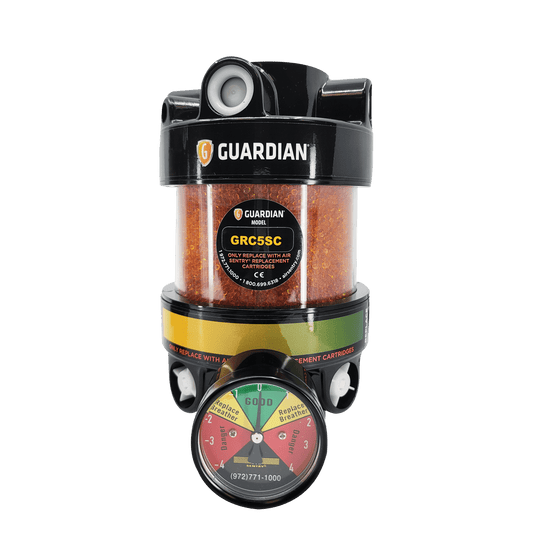
Air Sentry | Guardian - Small (9") | BEST - Desiccant Breather With Valves
Regular price From $355.00 USDRegular price

Collection: Air Sentry® Desiccant Breathers
The Gold Standard in Contamination Control
Since 1997, Air Sentry® desiccant breathers have set the industry standard for contamination control — revolutionizing breather technology with state-of-the-art features designed to minimize particulate and moisture contamination. Air Sentry was the first to introduce check valve technology and replaceable desiccant/filter cartridges, innovations that cut maintenance costs and dramatically extend product lifespan.
Good · Better · Best — Find Your Solution
| ★ Good | ★★ Better | ★★★ Best | |
|---|---|---|---|
| Series | Z-Series | X-Series | Guardian Series |
| Best For | Limited space applications | High humidity / high dust environments | Most applications — widest versatility |
| Disposable | ✓ Fully disposable | Replacement cartridges available | Replacement cartridges available |
| Check Valves | ✓ Included | ✓ Included | Optional add-on |
| Modular Add-ons | ✕ | ✕ | ✓ Customizable modular add-ons |
| Ideal When | Space is tight & budget is primary concern | Harsh environments demand extra filtration | Long-term reliability & flexibility needed |
Note: The D-Series (stationary applications, fully disposable) bridges Good and Better for standard fixed-equipment use cases.
5 Things to Consider When Selecting a Desiccant Breather
- Environment — Humidity levels, dust exposure, and ambient conditions
- Application — Stationary vs. mobile, reservoir type
- Airflow Rate — Volume of air exchanged per cycle
- Reservoir Capacity — Size of the equipment being protected
- Flow Characteristics — Pressure differentials and breathing frequency
Clear View 360° Design
Air Sentry breathers feature a 360° clear view design that makes it easy to inspect desiccant saturation from a distance. The inert silica gel transitions from gold → dark green to visually confirm moisture adsorption — so you always know the breather is doing its job without disassembly.
Breather Adapters
Complete your installation with Air Sentry Breather Adapter Kits and Adapters, designed to connect seamlessly with desiccant breathers across a wide range of equipment fittings.
Frequently Asked Questions
What are the main applications for desiccant breathers?
Desiccant breathers are used wherever airflow into a fluid reservoir can introduce moisture and particulate contamination — two of the leading causes of irreparable equipment damage and premature oil degradation. Key applications include:
- Hydraulic reservoir tanks — Stationary industrial hydraulic systems where clean, dry air exchange is critical to maintaining hydraulic fluid integrity and preventing valve and pump wear
- Industrial gearboxes — Gear oil is highly susceptible to water contamination, which accelerates oxidation, promotes rust, and dramatically shortens oil life; a desiccant breather keeps moisture out between oil changes
- Mobile hydraulic equipment — Garbage trucks, mining equipment, utility trucks, aerial lifts, and other mobile machinery breathe heavily during operation; without a breather, every cycle pulls in contaminated ambient air that degrades hydraulic fluid and clogs filters
- Diesel fuel tanks — Moisture ingress in diesel tanks promotes biological growth (microbial contamination / diesel bug) that clogs fuel filters, degrades fuel quality, and can cause injector damage; a desiccant breather on the tank vent eliminates the moisture that feeds this growth
- Turbines and compressors — High-value rotating equipment where lubricant cleanliness directly impacts uptime and overhaul intervals
- Storage tanks and drums — Long-term fluid storage is especially vulnerable to moisture absorption through tank vents during temperature cycling (thermal breathing)
- Agricultural equipment — Tractors, combines, and implements operating in dusty field conditions benefit from breathers on hydraulic and transmission reservoirs
In every case, the primary objective is the same: block particles and moisture from entering the system before they cause wear, corrosion, filter plugging, biological growth, or fluid breakdown — protecting both the equipment and the oil inside it.
What is a desiccant breather and what does it do?
A desiccant breather is a filtration device installed on equipment reservoirs, gearboxes, and storage tanks to remove moisture and particulate contamination from air as it enters and exits the system. It uses silica gel desiccant to adsorb water vapor and a filter media to capture dust and particles, protecting lubricants and hydraulic fluids from the #1 cause of equipment failure: contamination.
How do I know when an Air Sentry desiccant breather needs to be replaced?
Air Sentry breathers use color-changing silica gel that transitions from gold to dark green as it adsorbs moisture. When the majority of the desiccant has turned dark green, the breather has reached capacity and should be replaced or the cartridge swapped out (on X-Series and Guardian Series models). The 360° clear view design lets you check saturation at a glance without removing the breather.
What is the difference between the Z-Series, D-Series, X-Series, and Guardian Series?
The series are tiered by application complexity and reusability: the Z-Series is compact and fully disposable for tight spaces; the D-Series is fully disposable and suited for stationary equipment; the X-Series handles high humidity and high dust environments with replaceable cartridges; and the Guardian Series is the most versatile, offering replaceable cartridges and customizable modular add-ons for the widest range of applications.
Are Air Sentry desiccant breather cartridges replaceable?
Yes — on the X-Series and Guardian Series, the desiccant/filter cartridges are replaceable, reducing long-term maintenance costs and waste compared to fully disposable models. The Z-Series and D-Series are fully disposable and replaced as a complete unit.
What size desiccant breather do I need?
Sizing depends on five key factors: your environment (humidity, dust), the application type, the airflow rate of the system, the reservoir capacity, and the flow characteristics (pressure differential and breathing frequency). Use Air Sentry’s desiccant breather sizing tool or contact us for a Good / Better / Best recommendation tailored to your specific equipment.
Do Air Sentry breathers include check valves?
Air Sentry was the first in the industry to introduce check valve technology in desiccant breathers. Check valves are included on most series and are available as an optional modular add-on on the Guardian Series, giving you the flexibility to configure the breather to your exact application requirements.
How do desiccant breathers protect diesel fuel tanks?
Diesel tanks breathe as fuel is consumed and as temperatures fluctuate — pulling in ambient air through the tank vent with every cycle. That air carries moisture, which dissolves into the fuel and creates the ideal environment for microbial (biological) growth, commonly known as “diesel bug.” This biological contamination produces slime and biomass that rapidly clogs fuel filters, degrades fuel quality, and can cause injector damage. A desiccant breather on the tank vent removes moisture from incoming air before it enters the tank, eliminating the root cause of biological growth and keeping fuel clean and filters clear.


